Dielectrophoretic Particle
| Dielectrophoretic Particle | |
|---|---|
| State dimension: | 1 |
| Differential states: | 2 |
| Discrete control functions: | 2 |
The Dielectrophoretic Particle problem is a classical time-optimal control benchmark for microfluidic particle manipulation. This description is taken from [1]
It models the motion of a particle under a dielectrophoretic force, where the control voltage applied to electrodes directly influences the particle trajectory. Both the particle position and an auxiliary state related to its dipole moment, as well as the control voltage, are decision variables. The objective is to transfer the particle from an initial position to a target position in minimal time, while satisfying bounds on the control input and maintaining the auxiliary state dynamics.
Mathematical formulation
Parameters
These fixed values are used within the model:
| Symbol | Value | Description | |
|---|---|---|---|
| 1 | Initial particle position | ||
| 2 | Final particle position | ||
| -0.75 | Nonlinear coefficient | ||
| 1 | Damping coefficient |
Reference Solutions
Here is one local solution to the above control problem.
- Reference solution plots
-
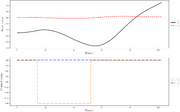 States and discretized control for a local optimum.

Miscellaneous and Further Reading
This formulation and a detailed description can be found in [1].
References
[1] Caillau, J.-B., Cots, O., Gergaud, J., & Martinon, P. OptimalControlProblems.jl: a collection of optimal control problems with ODE's in Julia. https://github.com/control-toolbox/OptimalControlProblems.jl/blob/main/ext/Descriptions/dielectrophoretic_particle.md