F-8 aircraft
| F-8 aircraft | |
|---|---|
| State dimension: | 1 |
| Differential states: | 3 |
| Discrete control functions: | 1 |
| Interior point equalities: | 6 |
The F-8 aircraft control problem is based on a very simple aircraft model. The control problem was introduced by Kaya and Noakes and aims at controlling an aircraft in a time-optimal way from an initial state to a terminal state.
The mathematical equations form a small-scale ODE model. The interior point equality conditions fix both initial and terminal values of the differential states.
The optimal integer control functions shows bang bang behavior. The problem is furthermore interesting as it should be reformulated equivalently.
Mathematical formulation
For almost everywhere the mixed-integer optimal control problem is given by
is the angle of attack in radians, is the pitch angle, is the pitch rate in rad/s, and the control function is the tail deflection angle in radians. This model goes back to Garrard<bibref>Garrard1977</bibref>.
In the control problem, both initial and terminal values of the differential states are fixed.
Reformulation
The control w(t) is restricted to take values from a finite set only. Hence, the control problem can be reformulated equivalently to
with . Note that there is a bijection between optimal solutions of the two problems.
Reference solutions
We provide here a comparison of different solutions reported in the literature. The numbers show the respective lengths of the switching arcs with the value of on the upper or lower bound (given in the second column). Claim denotes what is stated in the respective publication, Simulation shows values obtained by a simulation with a Runge-Kutta-Fehlberg method of 4th/5th order and an integration tolerance of .
| Arc | w(t) | Lee et al.<bibref>Lee1997a</bibref> | Kaya<bibref>Kaya2003</bibref> | Sager<bibref>Sager2005</bibref> | Schlueter/Gerdts | Sager |
|---|---|---|---|---|---|---|
| 1 | 1 | 0.00000 | 0.10292 | 0.10235 | 0.0 | 1.13492 |
| 2 | 0 | 2.18800 | 1.92793 | 1.92812 | 0.608750 | 0.34703 |
| 3 | 1 | 0.16400 | 0.16687 | 0.16645 | 3.136514 | 1.60721 |
| 4 | 0 | 2.88100 | 2.74338 | 2.73071 | 0.654550 | 0.69169 |
| 5 | 1 | 0.33000 | 0.32992 | 0.32994 | 0.0 | 0.0 |
| 6 | 0 | 0.47200 | 0.47116 | 0.47107 | 0.0 | 0.0 |
| Claim: Infeasibility | - | 1.00E-10 | 7.30E-06 | 5.90E-06 | 3.29169e-06 | 2.21723e-07 |
| Claim: Objective | - | 6.03500 | 5.74217 | 5.72864 | 4.39981 | 3.78086 |
| Simulation: Infeasibility | - | 1.75E-03 | 1.64E-03 | 5.90E-06 | 3.29169e-06 | 2.21723e-07 |
| Simulation: Objective | - | 6.03500 | 5.74218 | 5.72864 | 4.39981 | 3.78086 |
The best known optimal objective value of this problem given is given by . The corresponding solution is shown in the rightmost plot. The solution of bang-bang type switches three times, starting with .
- Reference solution plots
-
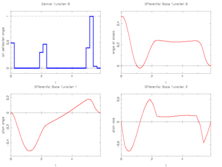 Optimal relaxed control on a coarse control discretization grid and corresponding differential states.
 -
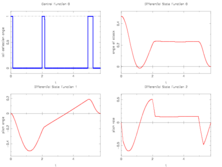 Optimal relaxed control on a fine, adaptively chosen control discretization grid and corresponding differential states.
 -
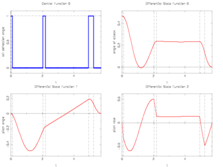 Optimal integer control and corresponding differential states.


Source Code
C
The differential equations in C code:
double x1 = xd[0];
double x2 = xd[1];
double x3 = xd[2];

double u0 = -0.05236;
double u1 = 0.05236;
double f00, f10, f20;
double f01, f11, f21;

f00 = - 0.877*x1 + x3 - 0.088*x1*x3 + 0.47*x1*x1 - 0.019*x2*x2
      - x1*x1*x3 + 3.846*x1*x1*x1 - 0.215*u0 + 0.28*x1*x1*u0 + 0.47*x1*u0*u0 + 0.63*u0*u0*u0;
f10 = x3;
f20 = - 4.208*x1 - 0.396*x3 - 0.47*x1*x1 - 3.564*x1*x1*x1
      - 20.967*u0 + 6.265*x1*x1*u0 + 46*x1*u0*u0 + 61.4*u0*u0*u0;

f01 = - 0.877*x1 + x3 - 0.088*x1*x3 + 0.47*x1*x1 - 0.019*x2*x2
      - x1*x1*x3 + 3.846*x1*x1*x1 - 0.215*u1 + 0.28*x1*x1*u1 + 0.47*x1*u1*u1 + 0.63*u1*u1*u1;
f11 = x3;
f21 = - 4.208*x1 - 0.396*x3 - 0.47*x1*x1 - 3.564*x1*x1*x1
      -20.967*u1 + 6.265*x1*x1*u1 + 46*x1*u1*u1 + 61.4*u1*u1*u1;

rhs[0] = u[0]*f01 + (1-u[0])*f00;
rhs[1] = u[0]*f11 + (1-u[0])*f10;
rhs[2] = u[0]*f21 + (1-u[0])*f20;
Miscellaneous and Further Reading
See <bibref>Kaya2003</bibref> and <bibref>Sager2005</bibref> for details.
References
<bibreferences/>