Moon Landing
| Moon Landing | |
|---|---|
| State dimension: | 1 |
| Differential states: | 3 |
| Discrete control functions: | 2 |
The Moon Landing problem is a simplification of a spacecraft trying to land on the moon's surface. Its objective is to minimize the fuel consumption during the landing maneuver while landing savely on the ground with zero vertical velocity.
The implementation here is taken from [1]. Its dynamics are given by a two-dimensional ODE model.
Mathematical formulation
Reference Solutions
Here is one local solution to the above control problem.
- Reference solution plots
-
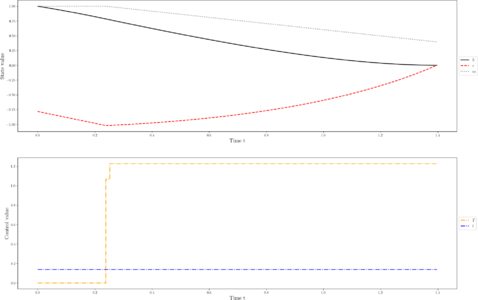 States and discretized control for a local optimum.

Miscellaneous and Further Reading
This formulation and a detailed description can be found in [1].
References
[1] Multidisciplinary Optimal Control Library: https://openmdao.org/dymos/docs/latest/examples/moon_landing/moon_landing.html
[2] Andrew William Moore. Efficient memory-based learning for robot control. Technical Report UCAM-CL-TR-209, University of Cambridge, Computer Laboratory, November 1990. URL: https://www.cl.cam.ac.uk/techreports/UCAM-CL-TR-209.pdf, doi:10.48456/tr-209.
[3] Alexey A Melnikov, Adi Makmal, and Hans J Briegel. Projective simulation applied to the grid-world and the mountain-car problem. arXiv preprint arXiv:1405.5459, 2014.