Dielectrophoretic Particle OED
| Dielectrophoretic Particle OED | |
|---|---|
| State dimension: | 1 |
| Differential states: | 13 |
| Discrete control functions: | 3 |
The Dielectrophoretic Particle OED problem is a variation of the Dielectrophoretic Particle problem. It looks for optimal time intervals to measure the two states in order to minimize the uncertainty of a follow-up parameter estimation problem for the two unknown parameters.
The mathematical equations form a small-scale ODE model. It also includes state sensitivities, the Fisher information matrix entries and integrated sampling states.
Mathematical formulation
We are interested in estimating the parameters and of the initial value problem
The initial values and are fixed. We are interested in how to fish and when to measure, with an upper bound on the measuring time. We can measure the states directly, and . We use two different sampling functions, and in the same experimental setting. This can be seen either as a two-dimensional measurement function , or as a special case of a multiple experiment, in which , and are identical.
Now we formulate the OED problem:
The evolution of the symmetric matrix is given by the weighted sum of observability Gramians for each observed function of states.
Parameters
We use and . The upper bound on the measurement time intervals is chosen as .
Reference Solutions
Here is one local solution to the above control problem.
- Reference solution plots
-
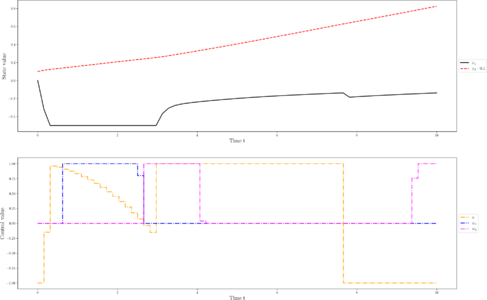 States, control, and sampling functions for a local optimum.

References
There were no citations found in the article.