Denbigh Reaction
| Denbigh Reaction | |
|---|---|
| State dimension: | 1 |
| Differential states: | 3 |
| Discrete control functions: | 1 |
The Mountain Car problem s based on the system of chemical reactions initially considered by Denbigh (1958), which was also studied by Aris (1960) and more recently by Luus (1994):
where X is an intermediate, Y is the desired product, and P and Q are waste products.
Its dynamics are given by a three-dimensional ODE model. The optimal integer control functions exhibits a bang bang structure.
Mathematical formulation
Reference Solutions
Here is one local solution to the above control problem.
- Reference solution plots
-
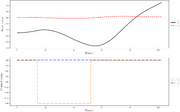 States and discretized control for a local optimum.

Miscellaneous and Further Reading
This formulation and a detailed description can be found in [1].
References
[1] Multidisciplinary Optimal Control Library: https://openmdao.org/dymos/docs/latest/examples/mountain_car/mountain_car.html
[2] Andrew William Moore. Efficient memory-based learning for robot control. Technical Report UCAM-CL-TR-209, University of Cambridge, Computer Laboratory, November 1990. URL: https://www.cl.cam.ac.uk/techreports/UCAM-CL-TR-209.pdf, doi:10.48456/tr-209.
[3] Alexey A Melnikov, Adi Makmal, and Hans J Briegel. Projective simulation applied to the grid-world and the mountain-car problem. arXiv preprint arXiv:1405.5459, 2014.