Van der Pol OED
| Van der Pol OED | |
|---|---|
| State dimension: | 1 |
| Differential states: | 11 |
| Discrete control functions: | 3 |
The Van der Pol problem is a variation of the Van der Pol problem. It looks for optimal time intervals to measure the two states in order to minimize the uncertainty of a follow-up parameter estimation problem for the two unknown parameters.
The mathematical equations form a small-scale ODE model. It also includes state sensitivities, the Fisher information matrix entries and integrated sampling states.
Mathematical formulation
We are interested in estimating the parameters and of the initial value problem
Additionally, we add the constraint
The initial values and are fixed. We are interested in how to fish and when to measure, with an upper bound on the measuring time. We can measure the states directly, and . We use two different sampling functions, and in the same experimental setting. This can be seen either as a two-dimensional measurement function , or as a special case of a multiple experiment, in which , and are identical. The experimental design problem then reads
with , , , , and , .
Note that the state has been left out for reasons of symmetry.
Parameters
We use , , and , . The upper bound on the measurement time intervals is chosen as .
Reference Solutions
Here is one local solution to the above control problem.
- Reference solution plots
-
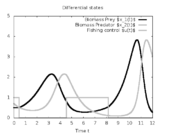 States and fishing control.
 -
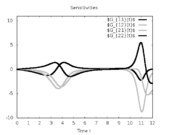 Sensitivities G().
 -
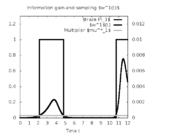 Sampling function for first state.
 -
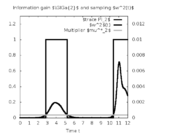 Sampling function for second state.


Source Code
Model descriptions are available in
Variants
There are several alternative formulations and variants of the above problem, in particular
- a prescribed time grid for the control function [Sager2006]Address: Heidelberg
Author: S. Sager; H.G. Bock; M. Diehl; G. Reinelt; J.P. Schl\"oder
Booktitle: Recent Advances in Optimization
Editor: A. Seeger
Note: ISBN 978-3-5402-8257-0
Pages: 269--289
Publisher: Springer
Series: Lectures Notes in Economics and Mathematical Systems
Title: Numerical methods for optimal control with binary control functions applied to a Lotka-Volterra type fishing problem
Volume: 563
Year: 2009 , see also Lotka Experimental Design (AMPL),
 - no fishing, i.e., ,
- different fishing control functions for the two species,
- different parameters and start values.
Miscellaneous and Further Reading
The Lotka Volterra fishing problem was introduced by Sebastian Sager in a proceedings paper [Sager2006]Address: Heidelberg
Author: S. Sager; H.G. Bock; M. Diehl; G. Reinelt; J.P. Schl\"oder
Booktitle: Recent Advances in Optimization
Editor: A. Seeger
Note: ISBN 978-3-5402-8257-0
Pages: 269--289
Publisher: Springer
Series: Lectures Notes in Economics and Mathematical Systems
Title: Numerical methods for optimal control with binary control functions applied to a Lotka-Volterra type fishing problem
Volume: 563
Year: 2009 and revisited in his PhD thesis [Sager2005]Address: Tönning, Lübeck, Marburg
Author: S. Sager
Editor: ISBN 3-89959-416-9
Publisher: Der andere Verlag
Title: Numerical methods for mixed--integer optimal control problems
Url: http://mathopt.de/PUBLICATIONS/Sager2005.pdf
Year: 2005. These are also the references to look for more details. The experimental design problem has been described in the habilitation thesis of Sager, [Sager2011d]Author: S. Sager
How published: University of Heidelberg
Month: August
Note: Habilitation
Title: On the Integration of Optimization Approaches for Mixed-Integer Nonlinear Optimal Control
Url: http://mathopt.de/PUBLICATIONS/Sager2011d.pdf
Year: 2011.
References
There were no citations found in the article.