Lotka Volterra absolute fishing problem: Difference between revisions
ClemensZeile (talk | contribs) Created page with "{{Dimensions |nd = 1 |nx = 3 |nw = 5 |nre = 3 }}<!-- Do not insert line break here or Dimensions Box moves up in the layout... -->This site describ..." |
ClemensZeile (talk | contribs) No edit summary |
||
| Line 46: | Line 46: | ||
== Reference Solutions == | == Reference Solutions == | ||
If the problem is relaxed, i.e., we demand that <math>w(t)</math> | If the problem is relaxed, i.e., we demand that <math>w(t)</math> is in the continuous interval <math>[0, 1]</math> rather than being binary, the optimal solution can be determined by means of direct optimal control. | ||
The optimal objective value of the relaxed problem with <math> n_t=12000, \, n_u= | The optimal objective value of the relaxed problem with <math> n_t=12000, \, n_u=150 </math> is <math>x_2(t_f) =0.345768563</math>. The objective value of the solution with binary controls obtained by Combinatorial Integral Approximation (CIA) is <math>x_2(t_f) =0.348617982</math>. | ||
<gallery caption="Reference solution plots" widths="180px" heights="140px" perrow="2"> | <gallery caption="Reference solution plots" widths="180px" heights="140px" perrow="2"> | ||
Revision as of 10:56, 14 October 2019
| Lotka Volterra absolute fishing problem | |
|---|---|
| State dimension: | 1 |
| Differential states: | 3 |
| Discrete control functions: | 5 |
| Interior point equalities: | 3 |
This site describes a Lotka Volterra variant with five binary controls that all represent fishing of an absolute biomass.
Mathematical formulation
The mixed-integer optimal control problem is given by
Here the differential states describe the biomasses of prey and predator, respectively. The third differential state is used here to transform the objective, an integrated deviation, into the Mayer formulation . This problem variant allows to choose between three different fishing options.
Parameters
These fixed values are used within the model.
Reference Solutions
If the problem is relaxed, i.e., we demand that is in the continuous interval rather than being binary, the optimal solution can be determined by means of direct optimal control.
The optimal objective value of the relaxed problem with is . The objective value of the solution with binary controls obtained by Combinatorial Integral Approximation (CIA) is .
- Reference solution plots
-
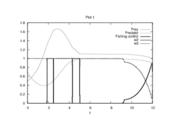 Optimal relaxed controls and states determined by an direct approach with ampl_mintoc (Radau collocation) and .
 -
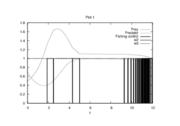 Optimal binary controls and states determined by an direct approach (Radau collocation) with ampl_mintoc and . The relaxed controls were approximated by Combinatorial Integral Approximation.

