Ducted Fan: Difference between revisions
RobertLampel (talk | contribs) |
RobertLampel (talk | contribs) |
||
| Line 40: | Line 40: | ||
{| border="1" align="center" cellpadding="5" cellspacing="0" | {| border="1" align="center" cellpadding="5" cellspacing="0" | ||
|- bgcolor=#c7c7c7 | |- bgcolor=#c7c7c7 | ||
! Symbol !! Value | ! Symbol !! Value | ||
|- | |- | ||
| align=center | <math> | | align=center | <math>m</math> || align=right | 2.2 <math>\mathrm{kg}</math> | ||
|- | |- | ||
| align=center | <math> | | align=center | <math>J</math> || align=right | 0.05 <math>\mathrm{kg \cdot m^2}</math> | ||
|- | |- | ||
| align=center | <math> | | align=center | <math>r</math> || align=right | 0.2 <math>\mathrm{m}</math> | ||
|- | |- | ||
| align=center | <math> | | align=center | <math>\mathrm{mg}</math> || align=right | 0.4 <math>\mathrm{N}</math> | ||
|- | |- | ||
| align=center | <math> | | align=center | <math>\mu</math> || align=right | 1 | ||
|} | |} | ||
Revision as of 10:15, 24 November 2025
| Ducted Fan | |
|---|---|
| State dimension: | 1 |
| Differential states: | 4 |
| Discrete control functions: | 1 |
The Ducted Fan problem is a classical nonlinear benchmark in optimal control with multiple input and state constraints. This description is taken from [1].
It models the planar motion of a ducted fan aircraft, described by its horizontal and vertical positions , the angle with respect to the vertical, and their velocities . The inputs are the body-fixed thrust components , generated by moving flaps at the end of the duct.
The objective is to steer the fan from the origin to a horizontal position of at altitude , with zero final velocities and attitude, in a free final time , while minimising a trade-off between control effort and transition time.
Mathematical formulation
We summarize the states as .
Parameters
These fixed values are used within the model:
| Symbol | Value |
|---|---|
| 2.2 | |
| 0.05 | |
| 0.2 | |
| 0.4 | |
| 1 |
Reference Solutions
Here is one local solution to the above control problem.
- Reference solution plots
-
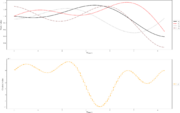 States and discretized control for a local optimum.

Miscellaneous and Further Reading
This formulation and a detailed description can be found in [1].
References
[1] Caillau, J.-B., Cots, O., Gergaud, J., & Martinon, P. OptimalControlProblems.jl: a collection of optimal control problems with ODE's in Julia. https://github.com/control-toolbox/OptimalControlProblems.jl/blob/main/ext/Descriptions/double_oscillator.md