Catalyst mixing problem: Difference between revisions
ClemensZeile (talk | contribs) |
ClemensZeile (talk | contribs) No edit summary |
||
| Line 19: | Line 19: | ||
<math> | <math> | ||
\begin{array}{llcl} | \begin{array}{llcl} | ||
\displaystyle \min_{x, | \displaystyle \min_{x, w} &-1 + x_1(t_f) + x_2(t_f) \\[1.5ex] | ||
\mbox{s.t.} | \mbox{s.t.} | ||
& \dot{x}_1 & = & | & \dot{x}_1 & = & w(t) ( 10 x_2(t) - x_1(t)), \\ | ||
& \dot{x}_2 & = & | & \dot{x}_2 & = & w(t) ( x_1(t) - 10 x_2(t)) - (1 - w(t)) \, x_2(t) , \\ | ||
& x(t_0) &=& (1, 0)^T, \\ | & x(t_0) &=& (1, 0)^T, \\ | ||
& | & w(t) &\in& \{0,1\}. | ||
\end{array} | \end{array} | ||
</math> | </math> | ||
| Line 32: | Line 32: | ||
In this model the parameters used are <math> t_0 = 0, \, \, t_f = 1 </math>. | In this model the parameters used are <math> t_0 = 0, \, \, t_f = 1 </math>. | ||
== Reference Solution == | |||
If the problem is relaxed, i.e., we demand that w(t) be in the continuous interval [0, 1] instead of the binary choice \{0,1\}, the optimal solution can be determined by means of direct optimal control. | |||
<gallery caption="Reference solution plots" widths="180px" heights="140px" perrow="2"> | |||
Image:Catalyst_Mixing_Problem_Performance.png| Results with relaxed controls and collocation from the [http://www.mcs.anl.gov/~more/cops/ COPS library] | |||
Image:Catalyst Mixing Controls.png| Optimal relaxed controls showing a bang-bang structure. | |||
</gallery> | |||
== Source Code == | == Source Code == | ||
Latest revision as of 19:15, 12 January 2018
| Catalyst mixing problem | |
|---|---|
| State dimension: | 1 |
| Differential states: | 2 |
| Continuous control functions: | 1 |
| Path constraints: | 2 |
| Interior point equalities: | 2 |
The Catalyst mixing problem seeks an optimal policy for mixing two catalysts "along the length of a tubular plug ow reactor involving several reactions". (Cite and problem taken from the COPS library)
Mathematical formulation
The problem is given by
Parameters
In this model the parameters used are .
Reference Solution
If the problem is relaxed, i.e., we demand that w(t) be in the continuous interval [0, 1] instead of the binary choice \{0,1\}, the optimal solution can be determined by means of direct optimal control.
- Reference solution plots
-
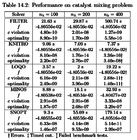 Results with relaxed controls and collocation from the COPS library
 -
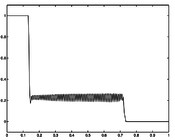 Optimal relaxed controls showing a bang-bang structure.


Source Code
Model descriptions are available in