Van der Pol Oscillator (binary variant): Difference between revisions
ClemensZeile (talk | contribs) Created page with "{{Dimensions |nd = 1 |nx = 2 |nw = 3 |nre = 2 }}<!-- Do not insert line break here or Dimensions Box moves up in the layout... -->This site describ..." |
ClemensZeile (talk | contribs) No edit summary |
||
| Line 14: | Line 14: | ||
<math> | <math> | ||
\begin{array}{lll} | \begin{array}{lll} | ||
\min\limits_{x,y,w} & \int\limits_{t_0}^{t_f} & (x(t)^2+y(t)^2 | \min\limits_{x,y,w} & \int\limits_{t_0}^{t_f} & (x(t)^2+y(t)^2 dt\\ | ||
s.t. & \dot x & = y,\\ | s.t. & \dot x & = y,\\ | ||
& \dot y & = \sum\limits_{i=1}^{3} c_{i}\; w_i \;(1-x^2) y-x,\\ | & \dot y & = \sum\limits_{i=1}^{3} c_{i}\; w_i \;(1-x^2) y-x,\\ | ||
| Line 32: | Line 32: | ||
If the problem is relaxed, i.e., we demand that <math>w(t)</math> be in the continuous interval <math>[0, 1]</math> instead of the binary choice <math>\{0,1\}</math>, the optimal solution can be determined by means of direct optimal control. | If the problem is relaxed, i.e., we demand that <math>w(t)</math> be in the continuous interval <math>[0, 1]</math> instead of the binary choice <math>\{0,1\}</math>, the optimal solution can be determined by means of direct optimal control. | ||
The optimal objective value of the relaxed problem with <math> n_t= | The optimal objective value of the relaxed problem with <math> n_t=6000, \, n_u=60 </math> is <math>1.30167235</math>. The objective value of the binary controls obtained by Combinatorial Integral Approimation (CIA) is <math>1.30273681</math>. | ||
<gallery caption="Reference solution plots" widths="180px" heights="140px" perrow="2"> | <gallery caption="Reference solution plots" widths="180px" heights="140px" perrow="2"> | ||
Image: | Image:VanderpolCIA_6000_100_1.pdf| Optimal relaxed controls and states determined by an direct approach with ampl_mintoc (Radau collocation) and <math>n_t=6000, \, n_u=60</math>. | ||
Image:MmlotkaCIA 12000 30 1.png| Optimal binary controls and states determined by an direct approach (Radau collocation) with ampl_mintoc and <math>n_t= | Image:MmlotkaCIA 12000 30 1.png| Optimal binary controls and states determined by an direct approach (Radau collocation) with ampl_mintoc and <math>n_t=6000, \, n_u=60</math>. The relaxed controls were approximated by Combinatorial Integral Approximation. | ||
</gallery> | </gallery> | ||
Revision as of 16:58, 10 January 2018
| Van der Pol Oscillator (binary variant) | |
|---|---|
| State dimension: | 1 |
| Differential states: | 2 |
| Discrete control functions: | 3 |
| Interior point equalities: | 2 |
This site describes a Van der Pol Oscillator variant with three binary controls instead of only one continuous control.
Mathematical formulation
The mixed-integer optimal control problem is given by
Parameters
These fixed values are used within the model:
Reference Solutions
If the problem is relaxed, i.e., we demand that be in the continuous interval instead of the binary choice , the optimal solution can be determined by means of direct optimal control.
The optimal objective value of the relaxed problem with is . The objective value of the binary controls obtained by Combinatorial Integral Approimation (CIA) is .
- Reference solution plots
-
 Optimal relaxed controls and states determined by an direct approach with ampl_mintoc (Radau collocation) and .
 -
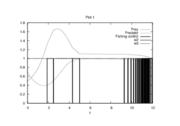 Optimal binary controls and states determined by an direct approach (Radau collocation) with ampl_mintoc and . The relaxed controls were approximated by Combinatorial Integral Approximation.
