Double Tank multimode problem: Difference between revisions
ClemensZeile (talk | contribs) Created page with "{{Dimensions |nd = 1 |nx = 3 |nw = 3 |nre = 2 }}<!-- Do not insert line break here or Dimensions Box moves up in the layout... -->This site describ..." |
ClemensZeile (talk | contribs) No edit summary |
||
| Line 23: | Line 23: | ||
</math> | </math> | ||
== Parameters == | == Parameters == | ||
| Line 30: | Line 28: | ||
These fixed values are used within the model. | These fixed values are used within the model. | ||
<math> | <math> T=10, c_1=1, c_2=0.5, c_3=2, k_1=2, k_2=3. </math> | ||
</math> | |||
== Reference Solutions == | == Reference Solutions == | ||
| Line 43: | Line 34: | ||
If the problem is relaxed, i.e., we demand that <math>w(t)</math> be in the continuous interval <math>[0, 1]</math> instead of the binary choice <math>\{0,1\}</math>, the optimal solution can be determined by means of direct optimal control. | If the problem is relaxed, i.e., we demand that <math>w(t)</math> be in the continuous interval <math>[0, 1]</math> instead of the binary choice <math>\{0,1\}</math>, the optimal solution can be determined by means of direct optimal control. | ||
The optimal objective value of the relaxed problem with <math> n_t=12000, \, n_u= | The optimal objective value of the relaxed problem with <math> n_t=12000, \, n_u=100 </math> is <math>2.59106823</math>. The objective value of the binary controls obtained by Combinatorial Integral Approimation (CIA) is <math>2.59121008</math>. | ||
<gallery caption="Reference solution plots" widths="180px" heights="140px" perrow="2"> | <gallery caption="Reference solution plots" widths="180px" heights="140px" perrow="2"> | ||
Image: | Image:MmlotkaRelaxed_12000_120_1.png| Optimal relaxed controls and states determined by an direct approach with ampl_mintoc (Radau collocation) and <math>n_t=12000, \, n_u=100</math>. | ||
Image: | Image:MmdoubletankCIA_12000_120_1.png| Optimal binary controls and states determined by an direct approach (Radau collocation) with ampl_mintoc and <math>n_t=12000, \, n_u=100</math>. The relaxed controls were approximated by Combinatorial Integral Approximation. | ||
</gallery> | </gallery> | ||
Revision as of 15:25, 10 January 2018
| Double Tank multimode problem | |
|---|---|
| State dimension: | 1 |
| Differential states: | 3 |
| Discrete control functions: | 3 |
| Interior point equalities: | 2 |
This site describes a Double tank problem variant with three binary controls instead of only one control.
Mathematical formulation
The mixed-integer optimal control problem is given by
Parameters
These fixed values are used within the model.
Reference Solutions
If the problem is relaxed, i.e., we demand that be in the continuous interval instead of the binary choice , the optimal solution can be determined by means of direct optimal control.
The optimal objective value of the relaxed problem with is . The objective value of the binary controls obtained by Combinatorial Integral Approimation (CIA) is .
- Reference solution plots
-
Optimal relaxed controls and states determined by an direct approach with ampl_mintoc (Radau collocation) and .
-
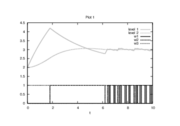 Optimal binary controls and states determined by an direct approach (Radau collocation) with ampl_mintoc and . The relaxed controls were approximated by Combinatorial Integral Approximation.

