Egerstedt standard problem: Difference between revisions
ClemensZeile (talk | contribs) No edit summary |
ClemensZeile (talk | contribs) No edit summary |
||
| Line 38: | Line 38: | ||
<gallery caption="Reference solution plots" widths="180px" heights="140px" perrow="2"> | <gallery caption="Reference solution plots" widths="180px" heights="140px" perrow="2"> | ||
Image: | Image:EgerstedtRelaxed 6000 150 1.png| Optimal relaxed controls and states determined by an direct approach with ampl_mintoc (Radau collocation) and <math>n_t=6000, \, n_u=40</math>. | ||
Image: | Image:EgerstedtCIA 6000 150 1.png| Optimal binary controls and states determined by an direct approach (Radau collocation) with ampl_mintoc and <math>n_t=6000, \, n_u=40</math>. The relaxed controls were approximated by Combinatorial Integral Approximation. | ||
</gallery> | </gallery> | ||
| Line 47: | Line 47: | ||
Model descriptions are available in | Model descriptions are available in | ||
* [[:Category:AMPL | AMPL code]] at [[Lotka Volterra fishing problem (AMPL)]] | * [[:Category:AMPL | AMPL code]] at [[Lotka Volterra fishing problem (AMPL)]] | ||
== References == | == References == | ||
| Line 79: | Line 58: | ||
[[Category:ODE model]] | [[Category:ODE model]] | ||
[[Category:Tracking objective]] | [[Category:Tracking objective]] | ||
[[Category:Sensitivity-seeking arcs]] | [[Category:Sensitivity-seeking arcs]] | ||
Revision as of 13:29, 10 January 2018
| Egerstedt standard problem | |
|---|---|
| State dimension: | 1 |
| Differential states: | 3 |
| Discrete control functions: | 3 |
| Path constraints: | 1 |
| Interior point equalities: | 3 |
The Egerstedt standard problemm is the problem is of an academic nature and was proposed by Egerestedt to highlight the features of an Hybrid System algorithm in 2006 [Egerstedt2006]Author: M. Egerstedt; Y. Wardi; H. Axelsson
Journal: IEEE Transactions on Automatic Control
Pages: 110--115
Title: Transition-time optimization for switched-mode dynamical systems
Volume: 51
Year: 2006 . It has been used since then in many MIOCP research studies (e.g. [Jung2013]Author: M. Jung; C. Kirches; S. Sager
Booktitle: Facets of Combinatorial Optimization -- Festschrift for Martin Gr\"otschel
Editor: M. J\"unger and G. Reinelt
Pages: 387--417
Publisher: Springer Berlin Heidelberg
Title: On Perspective Functions and Vanishing Constraints in Mixed-Integer Nonlinear Optimal Control
Url: http://www.mathopt.de/PUBLICATIONS/Jung2013.pdf
Year: 2013) for benchmarking of MIOCP algorithms.
Mathematical formulation
The mixed-integer optimal control problem after partial outer convexification is given by
for .
Reference Solutions
If the problem is relaxed, i.e., we demand that be in the continuous interval instead of the binary choice , the optimal solution can be determined by using a direct method such as collocation or Bock's direct multiple shooting method.
The optimal objective value of the relaxed problem with is . The objective value of the binary controls obtained by Combinatorial Integral Approimation (CIA) is . The binary control solution was evaluated in the MIOCP by using a Merit function with additional Lagrange term .
- Reference solution plots
-
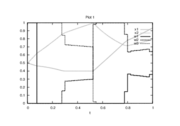 Optimal relaxed controls and states determined by an direct approach with ampl_mintoc (Radau collocation) and .
 -
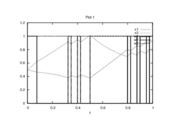 Optimal binary controls and states determined by an direct approach (Radau collocation) with ampl_mintoc and . The relaxed controls were approximated by Combinatorial Integral Approximation.


Source Code
Model descriptions are available in
References
| [Egerstedt2006] | M. Egerstedt; Y. Wardi; H. Axelsson (2006): Transition-time optimization for switched-mode dynamical systems. IEEE Transactions on Automatic Control, 51, 110--115 | |
| [Jung2013] | M. Jung; C. Kirches; S. Sager (2013): On Perspective Functions and Vanishing Constraints in Mixed-Integer Nonlinear Optimal Control. Facets of Combinatorial Optimization -- Festschrift for Martin Gr\"otschel | |
We present numerical results for a benchmark MIOCP from a previous study [157] with the addition of switching constraints. In its original form, the problem was:
After partial outer convexification with respect to the integer control v, the binary
convexified counterpart problem reads