Goddart's rocket problem: Difference between revisions
FelixMueller (talk | contribs) |
FelixMueller (talk | contribs) |
||
| Line 26: | Line 26: | ||
& m(0) &=& m_0, \\ | & m(0) &=& m_0, \\ | ||
& r(T) &=& r_T, \\ | & r(T) &=& r_T, \\ | ||
& D(r( | & D(r(t),v(t))&\le& C \\ | ||
& T free | & T free | ||
\end{array} | \end{array} | ||
Revision as of 11:13, 19 January 2016
In Goddart's rocket problem we model the ascent (vertical; restricted to 1 dimension) of a rocket. The aim is to reach a certain altitude with minimal fuel consumption. It is equivalent to maximize the mass at the final altitude.
Variables
The state variables describe the altitude(radius), speed and mass.
The drag is given by
All units are renormalized.
Mathematical formulation
Parameters
Reference Solution
The following reference solution was generated using BOCOP. The optimal value of the objective function is -0.63389.
- Reference solution plots
-
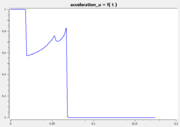 Control u over time.
 -
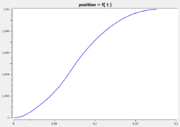 Position r over time.
 -
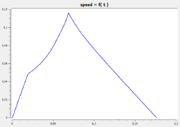 Speed v over time.
 -
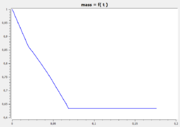 Mass m over time.


References
The Problem can be found in the BOCOP User Guide.