Moon Landing: Difference between revisions
RobertLampel (talk | contribs) Created page with "{{Dimensions |nd = 1 |nx = 3 |nw = 2 }} The '''Moon Landing problem''' is a simplification of a spacecraft trying to land on the moon's surface. Its objective is to minimize the fuel consumption during the landing maneuver while landing savely on the ground with zero vertical velocity. The implementation here is taken from [1]. Its dynamics are given by a two-dimensional ODE model. == Mathematical formulatio..." |
RobertLampel (talk | contribs) |
||
| (6 intermediate revisions by the same user not shown) | |||
| Line 14: | Line 14: | ||
<math> | <math> | ||
\begin{array}{lll} | \begin{array}{lll} | ||
\displaystyle \min_{ | \displaystyle \min_{T, t_\mathrm{f}} && -m(t_\mathrm{f}) \\ | ||
\text{subject to} \\ | \text{subject to} \\ | ||
\quad \dot{h}(t) & = & v(t),\\ | \quad \dot{h}(t) & = & v(t),\\ | ||
\quad \dot{v}(t) & = & -1 + \frac{T(t)}{m}, \\ | \quad \dot{v}(t) & = & -1 + \frac{T(t)}{m(t)}, \\ | ||
\quad \dot{m}(t) & = & -\frac{T(t)}{2.349}, \\ | \quad \dot{m}(t) & = & -\frac{T(t)}{2.349}, \\ | ||
\quad h(0) &=& 1, \\ | \quad h(0) &=& 1, \\ | ||
\quad v(0) &=& -0.783, \\ | \quad v(0) &=& -0.783, \\ | ||
\quad m(0) &=& 1, \\ | \quad m(0) &=& 1, \\ | ||
\quad h( | \quad t_\mathrm{f} &\geq& 0, \\ | ||
\quad v( | \quad h(t_\mathrm{f}) &=& 0, \\ | ||
\quad T(t) & \in & [0, 1.227] \ \quad \forall t \in [0, | \quad v(t_\mathrm{f}) &=& 0, \\ | ||
\quad T(t) & \in & [0, 1.227] \ \quad \forall t \in [0,t_\mathrm{f}] | |||
\end{array} | \end{array} | ||
</math> | </math> | ||
| Line 34: | Line 35: | ||
<gallery caption="Reference solution plots" widths="500px" heights="300px" perrow="1"> | <gallery caption="Reference solution plots" widths="500px" heights="300px" perrow="1"> | ||
Image:Moon_Landing.png| States and discretized control for a local optimum. | Image:Moon_Landing.png| States and discretized control for a local optimum. The free end time <math>t_\mathrm{f}</math> was modeled using the additional control <math>t</math>. | ||
</gallery> | </gallery> | ||
| Line 41: | Line 42: | ||
== References == | == References == | ||
<span id="openmdao">[1]</span> Multidisciplinary Optimal Control Library: https://openmdao.org/dymos/docs/latest/examples/moon_landing/moon_landing.html | <span id="openmdao">[1]</span> Multidisciplinary Optimal Control Library: https://openmdao.org/dymos/docs/latest/examples/moon_landing/moon_landing.html | ||
[[Category:MIOCP]] | [[Category:MIOCP]] | ||
[[Category:Bang bang]] | [[Category:Bang bang]] | ||
Latest revision as of 17:25, 22 February 2026
| Moon Landing | |
|---|---|
| State dimension: | 1 |
| Differential states: | 3 |
| Discrete control functions: | 2 |
The Moon Landing problem is a simplification of a spacecraft trying to land on the moon's surface. Its objective is to minimize the fuel consumption during the landing maneuver while landing savely on the ground with zero vertical velocity.
The implementation here is taken from [1]. Its dynamics are given by a two-dimensional ODE model.
Mathematical formulation
Reference Solutions
Here is one local solution to the above control problem.
- Reference solution plots
-
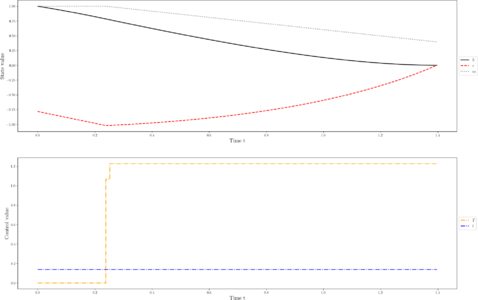 States and discretized control for a local optimum. The free end time was modeled using the additional control .

Miscellaneous and Further Reading
This formulation and a detailed description can be found in [1].
References
[1] Multidisciplinary Optimal Control Library: https://openmdao.org/dymos/docs/latest/examples/moon_landing/moon_landing.html