Compartmental OED: Difference between revisions
RobertLampel (talk | contribs) |
RobertLampel (talk | contribs) |
||
| (7 intermediate revisions by the same user not shown) | |||
| Line 5: | Line 5: | ||
}} | }} | ||
The '''Compartmental OED problem''' looks for an optimal measurement strategy to determine | The '''Compartmental OED problem''' looks for an optimal measurement strategy to determine three parameters in a one-dimensional [[:Category:ODE model|ODE model]], where we can directly measure the single state. The following description is taken from [[#compartmental| [1]]]. | ||
Here we consider the open one-compartment model with first-order absorption input fitted by Button (unpublished Ph.D. thesis, Texas A&M University, 1979) to the results of an experiment in which six horses each received 15 mg/kg of theophylline as aminophylline by intragastric administration. | Here we consider the open one-compartment model with first-order absorption input fitted by Button (unpublished Ph.D. thesis, Texas A&M University, 1979) to the results of an experiment in which six horses each received 15 mg/kg of theophylline as aminophylline by intragastric administration. | ||
| Line 14: | Line 14: | ||
For the three-dimensional parameter <math>p = (\theta_1, \theta_2, \theta_3)</math> the original initial value problem is given by | For the three-dimensional parameter <math>p = (\theta_1, \theta_2, \theta_3)</math> the original initial value problem is given by | ||
<math> | <math> | ||
\dot{ | \dot{y}(t) = f(t, p) = \theta_3 \cdot (-\theta_1 \cdot \exp(-\theta_1 \cdot t) + \theta_2 \cdot \exp(-\theta_2 \cdot t)), \quad y(0) = 0. | ||
</math> | </math> | ||
| Line 43: | Line 43: | ||
<p> | <p> | ||
<math> | <math> | ||
t_f = 40; \quad \mathcal{W} = [0,1]; \quad M = 5; \quad p = (0.05884,4.298,21.80) | y_0 = 0; \quad t_f = 40; \quad \mathcal{W} = [0,1]; \quad M = 5; \quad p = (0.05884,4.298,21.80) | ||
</math> | </math> | ||
</p> | </p> | ||
| Line 51: | Line 51: | ||
Here is one local solution to the above control problem. | Here is one local solution to the above control problem. | ||
<gallery caption="Reference solution plots" widths=" | <gallery caption="Reference solution plots" widths="500px" heights="300px" perrow="1"> | ||
Image:Compartmental OED.png| Sensitivities and measurement control for <math>\theta=(0.05884, 4.298, 21.80)</math>. | Image:Compartmental OED.png| Sensitivities and measurement control for <math>\theta=(0.05884, 4.298, 21.80)</math>. | ||
</gallery> | </gallery> | ||
Latest revision as of 10:18, 26 March 2026
| Compartmental OED | |
|---|---|
| State dimension: | 1 |
| Differential states: | 12 |
| Discrete control functions: | 1 |
The Compartmental OED problem looks for an optimal measurement strategy to determine three parameters in a one-dimensional ODE model, where we can directly measure the single state. The following description is taken from [1].
Here we consider the open one-compartment model with first-order absorption input fitted by Button (unpublished Ph.D. thesis, Texas A&M University, 1979) to the results of an experiment in which six horses each received 15 mg/kg of theophylline as aminophylline by intragastric administration.
The optimal integer control functions shows bang bang behavior.
Mathematical formulation
For the three-dimensional parameter the original initial value problem is given by
We assume both and to be fixed and are only interested in when to measure, with an upper bound on the measuring time. We can measure the state directly, i.e. .
Now we formulate the OED problem:
Parameters
These fixed values are used within the model:
Reference Solutions
Here is one local solution to the above control problem.
- Reference solution plots
-
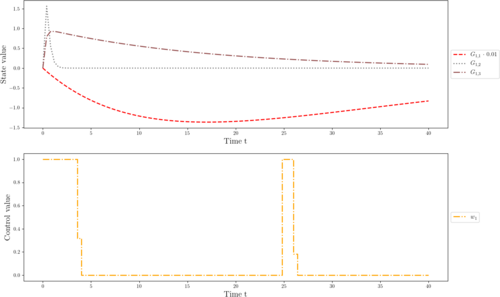 Sensitivities and measurement control for .

References
[1] Optimum Experimental Designs for Properties of a Compartmental Model, A. Atkinson, K. Chaloner, A. Herzberg, J. Juritz, https://www.jstor.org/stable/pdf/2532547.pdf