Ocean: Difference between revisions
RobertLampel (talk | contribs) |
RobertLampel (talk | contribs) |
||
| (11 intermediate revisions by the same user not shown) | |||
| Line 1: | Line 1: | ||
{{Dimensions | {{Dimensions | ||
|nd = 1 | |nd = 1 | ||
|nx = | |nx = 3 | ||
|nw = | |nw = 2 | ||
}} | }} | ||
The '''Ocean problem''' describes fossil fuel consumption and sequestration into the ocean [ | The '''Ocean problem''' describes fossil fuel consumption and sequestration into the ocean [[#PersonalComm | [1]]]. It is a | ||
two box model where <math>S</math> describes the carbon stock in the atmosphere and upper layer ocean, | two box model where <math>S</math> describes the carbon stock in the atmosphere and upper layer ocean, | ||
<math>R</math> describes the carbon stock in fossil reserve and <math>D_L</math> the carbon stock in the deeper layer. The dynamics are given by an [[:Category:ODE model|ODE model]]. | <math>R</math> describes the carbon stock in fossil reserve and <math>D_L</math> the carbon stock in the deeper layer. The dynamics are given by an [[:Category:ODE model|ODE model]]. | ||
| Line 15: | Line 15: | ||
<math> | <math> | ||
\begin{array}{lll} | \begin{array}{lll} | ||
\displaystyle \min_{w} && y(t_f) \\ | \displaystyle \min_{w} && -y(t_f) \\ | ||
\text{subject to} \\ | \text{subject to} \\ | ||
\quad \dot{y}(t) & = & \exp(-\rho \cdot t) \cdot (U(t)- A(t) - u_1(t) \cdot C(t) - D(t)),\\ | \quad \dot{y}(t) & = & \exp(-\rho \cdot t) \cdot (U(t)- A(t) - u_1(t) \cdot C(t) - D(t)),\\ | ||
| Line 22: | Line 22: | ||
\quad y(0) &=& 0, \\ | \quad y(0) &=& 0, \\ | ||
\quad S(0) &=& 2 \cdot 10^3, \\ | \quad S(0) &=& 2 \cdot 10^3, \\ | ||
\quad R(0) &=& 10^4 | \quad R(0) &=& 10^4 \\ | ||
\quad S(t), R(t) & \in & [0,10^5], \\ | |||
\quad u_1(t), u_2(t) & \in & [0,40] \\ | |||
\end{array} | \end{array} | ||
</math> | </math> | ||
| Line 40: | Line 42: | ||
</math> | </math> | ||
</p> | </p> | ||
== Parameters == | |||
{| class="wikitable" | |||
|+Parameters | |||
|- | |||
|Symbol | |||
|Value | |||
|- | |||
|<math>t_f</math> | |||
|<math>400</math> | |||
|- | |||
|<math>\rho</math> | |||
|<math>0.03</math> | |||
|- | |||
|<math>\gamma</math> | |||
|<math>0.001</math> | |||
|- | |||
|<math>\omega</math> | |||
|<math>0.1</math> | |||
|- | |||
|<math>b</math> | |||
|<math>50</math> | |||
|- | |||
|<math>\mu</math> | |||
|<math>0.5</math> | |||
|- | |||
|<math>a_1</math> | |||
|<math>2</math> | |||
|- | |||
|<math>a_2</math> | |||
|<math>2</math> | |||
|- | |||
|<math>\nu</math> | |||
|<math>1</math> | |||
|- | |||
|<math>c_1</math> | |||
|<math>50</math> | |||
|- | |||
|<math>c_2</math> | |||
|<math>0.004</math> | |||
|- | |||
|<math>S_{\text{preind}}</math> | |||
|<math>600</math> | |||
|- | |||
|<math>S_0</math> | |||
|<math>2000</math> | |||
|- | |||
|<math>R_0</math> | |||
|<math>10^4</math> | |||
|- | |||
|<math>D_{L,0}</math> | |||
|<math>2.3 \cdot 10^4</math> | |||
|} | |||
== Reference Solutions == | == Reference Solutions == | ||
| Line 45: | Line 101: | ||
Here is one local solution to the above control problem. | Here is one local solution to the above control problem. | ||
<gallery caption="Reference solution plots" widths=" | <gallery caption="Reference solution plots" widths="500px" heights="300px" perrow="1"> | ||
Image: | Image:Ocean.png| States and discretized control for a local optimum. Due to the explicit time dependence the time <math>t</math> was added as an additional state. | ||
</gallery> | </gallery> | ||
== Miscellaneous and Further Reading == | == Miscellaneous and Further Reading == | ||
The problem description and further references can be found in the PhD thesis of | The problem description and further references can be found in the PhD thesis of Dennis Janka [[#JankaPhD|[2]]]. | ||
== References == | == References == | ||
<span id=" | <span id="PersonalComm">[1]</span> W. Rickels and S. Sager. Personal communication. 2015. <br> | ||
<span id="JankaPhD">[2]</span> Janka, D.: Sequential quadratic programming with indefinite Hessian approximations for nonlinear optimum experimental design for parameter estimation in differential-algebraic equations. Ph.D. thesis, Ruprecht-Karls-Universität Heidelberg (2015). URL https://mathopt.de/publications/Janka2015.pdf <br> | |||
[[Category:MIOCP]] | [[Category:MIOCP]] | ||
[[Category:Sensitivity-seeking arcs]] | [[Category:Sensitivity-seeking arcs]] | ||
Latest revision as of 10:50, 29 January 2026
| Ocean | |
|---|---|
| State dimension: | 1 |
| Differential states: | 3 |
| Discrete control functions: | 2 |
The Ocean problem describes fossil fuel consumption and sequestration into the ocean [1]. It is a two box model where describes the carbon stock in the atmosphere and upper layer ocean, describes the carbon stock in fossil reserve and the carbon stock in the deeper layer. The dynamics are given by an ODE model.
The optimal control function exhibits a singular arc.
Mathematical formulation
with auxiliary functions
Parameters
| Symbol | Value |
Reference Solutions
Here is one local solution to the above control problem.
- Reference solution plots
-
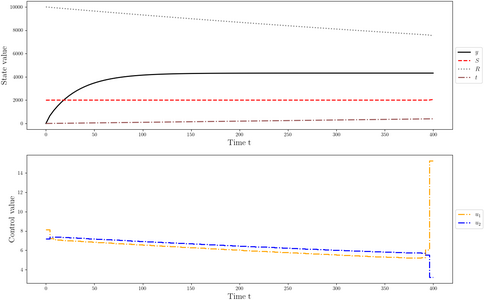 States and discretized control for a local optimum. Due to the explicit time dependence the time was added as an additional state.

Miscellaneous and Further Reading
The problem description and further references can be found in the PhD thesis of Dennis Janka [2].
References
[1] W. Rickels and S. Sager. Personal communication. 2015.
[2] Janka, D.: Sequential quadratic programming with indefinite Hessian approximations for nonlinear optimum experimental design for parameter estimation in differential-algebraic equations. Ph.D. thesis, Ruprecht-Karls-Universität Heidelberg (2015). URL https://mathopt.de/publications/Janka2015.pdf