Bang-bang approximation of a traveling wave: Difference between revisions
mNo edit summary |
FelixMueller (talk | contribs) No edit summary |
||
| (2 intermediate revisions by one other user not shown) | |||
| Line 1: | Line 1: | ||
{{Dimensions | |||
|nd = 2 | |||
|nx = 1 | |||
|nw = 1 | |||
|nc = 2 | |||
}} | |||
The following problem is an academic example of a PDE constrained optimal control problem with integer control constraints | The following problem is an academic example of a PDE constrained optimal control problem with integer control constraints | ||
and was introduced in < | and was introduced in <bib id="Hante2009" />. | ||
The control task consists of choosing the boundary value of a transport equation from the extremal values of a traveling | The control task consists of choosing the boundary value of a transport equation from the extremal values of a traveling | ||
| Line 47: | Line 54: | ||
== References == | == References == | ||
< | <biblist /> | ||
<!--List of all categories this page is part of. List characterization of solution behavior, model properties, ore presence of implementation details (e.g., AMPL for AMPL model) here --> | <!--List of all categories this page is part of. List characterization of solution behavior, model properties, ore presence of implementation details (e.g., AMPL for AMPL model) here --> | ||
Latest revision as of 15:02, 27 January 2016
| Bang-bang approximation of a traveling wave | |
|---|---|
| State dimension: | 2 |
| Differential states: | 1 |
| Discrete control functions: | 1 |
| Path constraints: | 2 |
The following problem is an academic example of a PDE constrained optimal control problem with integer control constraints
and was introduced in [Hante2009]Address: Berlin, Heidelberg
Author: Hante, Falk M.; Leugering, G\"unter
Booktitle: HSCC '09: Proceedings of the 12th International Conference on Hybrid Systems: Computation and Control
Pages: 209--222
Publisher: Springer-Verlag
Title: Optimal Boundary Control of Convention-Reaction Transport Systems with Binary Control Functions
Year: 2009 .
.
The control task consists of choosing the boundary value of a transport equation from the extremal values of a traveling wave such that the -distance between the traveling wave and the resulting flow is minimized.
Mathematical formulation
where
is the traveling wave (oscillating between 0 and 1), is a (small) regularization parameter and denotes the variation of over the interval . Thereby, the solution of the transport equation has to be understood in the usual weak sense defined by the characteristic equations. Systems biology
Reference solution
For the best known solution is given by
where denotes the indicator function of the interval .
- Obtained solution plots
-
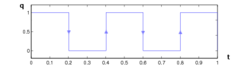 Solution obtained using a projected gradient method based on switching time sensitivities.
 -
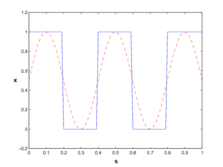 Corresponding plots of the differential states (blue) and the wave (red) at .


References
| [Hante2009] | Hante, Falk M.; Leugering, G\"unter (2009): Optimal Boundary Control of Convention-Reaction Transport Systems with Binary Control Functions. Springer-Verlag, HSCC '09: Proceedings of the 12th International Conference on Hybrid Systems: Computation and Control | |